
The most common causes of back pain in office workers are prolonged sitting, poor posture, a poorly configured workstation, insufficient movement throughout the day, and weak core and glute muscles. These factors rarely act alone. Most desk workers experience back pain as a result of several of these issues compounding over time, making prevention a matter of addressing the whole working environment rather than any single habit.
Back pain is one of the leading reasons people take sick leave from office jobs, and the underlying causes are almost always structural and behavioral rather than the result of a single incident. Understanding what drives the problem makes it far easier to fix. The sections below break down each major cause and what you can do about it.
How does prolonged sitting damage your back?
Prolonged sitting damages your back by placing sustained, uneven pressure on the spinal discs, compressing the lumbar vertebrae, and shortening the hip flexor muscles. Unlike standing or walking, sitting removes the natural load distribution that keeps spinal structures healthy. Over hours and days, this compression contributes to disc degeneration, muscle tightness, and chronic lower back pain.
When you sit, particularly in a slightly forward-leaning position common at a desk, the pressure on your lumbar discs increases significantly compared to standing. This sustained compression limits the disc’s ability to absorb nutrients and fluid, which it normally does through the pumping action of movement. Without regular movement, discs become less resilient and more prone to injury.
Beyond the spine itself, prolonged sitting causes the hip flexors to adaptively shorten. When you eventually stand up, these tight muscles pull the pelvis forward into an anterior tilt, which forces the lower back into an exaggerated curve. This position puts the lumbar muscles under continuous strain, which is a primary driver of the lower back pain so many desk workers experience by the end of the day. Swelling of the legs is also a common side effect of long static sitting periods, as poor circulation affects the lower limbs and can contribute to general discomfort and fatigue.
What posture mistakes cause the most back pain at a desk?
The posture mistakes that cause the most back pain at a desk are slouching in the lower back, protruding the head forward toward the screen, rounding the shoulders, and crossing the legs. Each of these positions places abnormal stress on specific areas of the spine and the muscles that support it, leading to neck pain, shoulder pain, and lower back pain over time.
Slouching and lumbar collapse
When the lower back loses its natural inward curve and collapses into a rounded position, the lumbar discs bear uneven pressure, and the surrounding muscles work overtime to compensate. This is the single most common postural cause of lower back pain in office workers. The problem is that slouching feels comfortable in the short term, which makes it easy to drift into without noticing.
Forward head posture and rounded shoulders
For every inch the head moves forward of the shoulders, the effective load on the cervical spine increases substantially. This is why neck pain and shoulder pain are so closely linked to desk work. Rounded shoulders compound the issue by reducing the space available for the shoulder joints and tightening the chest muscles, which in turn pulls the upper spine into a kyphotic curve. The result is a chain of tension running from the base of the skull down through the mid-back.
Why does a poorly set up workstation cause back pain?
A poorly set up workstation causes back pain because it forces the body to hold unnatural positions for hours at a time. When the screen is too low, too high, or too far away, or when the chair height does not allow the feet to rest flat on the floor, the body compensates with posture adjustments that accumulate into chronic musculoskeletal strain. Ergonomics is not about comfort alone. It is about reducing the physical cost of sustained work.
Common workstation errors include a monitor positioned too low, which encourages the head to drop forward and the upper back to round. A screen that is too high forces the neck into extension, straining the muscles at the back of the neck. Keyboard and mouse placement that requires reaching forward or upward creates persistent tension in the shoulders and upper back.
In home office settings, the problem is often more pronounced because workers use kitchen tables, sofas, or non-adjustable chairs that were never designed for extended work sessions. An ergonomic laptop stand, for example, can make an immediate difference by raising the screen to eye level, reducing the neck and shoulder load that builds up when looking down at a flat laptop for hours. Addressing workstation setup is one of the most direct and cost-effective ways to reduce back and neck pain without changing work habits dramatically.
How does lack of movement during the workday worsen back pain?
Lack of movement during the workday worsens back pain by allowing muscles to fatigue in static positions, reducing circulation to spinal tissues, and preventing the natural load variation that keeps the spine healthy. The human body is designed for frequent positional changes, not sustained stillness. When movement is absent for long periods, even a well-supported sitting position becomes damaging.
Static postures, regardless of how ergonomically correct they are, cause muscles to hold isometric contractions for extended periods. This leads to localized fatigue, reduced blood flow, and a buildup of metabolic waste products in the tissue. The result is the familiar aching stiffness that sets in after an hour or two at a desk without a break.
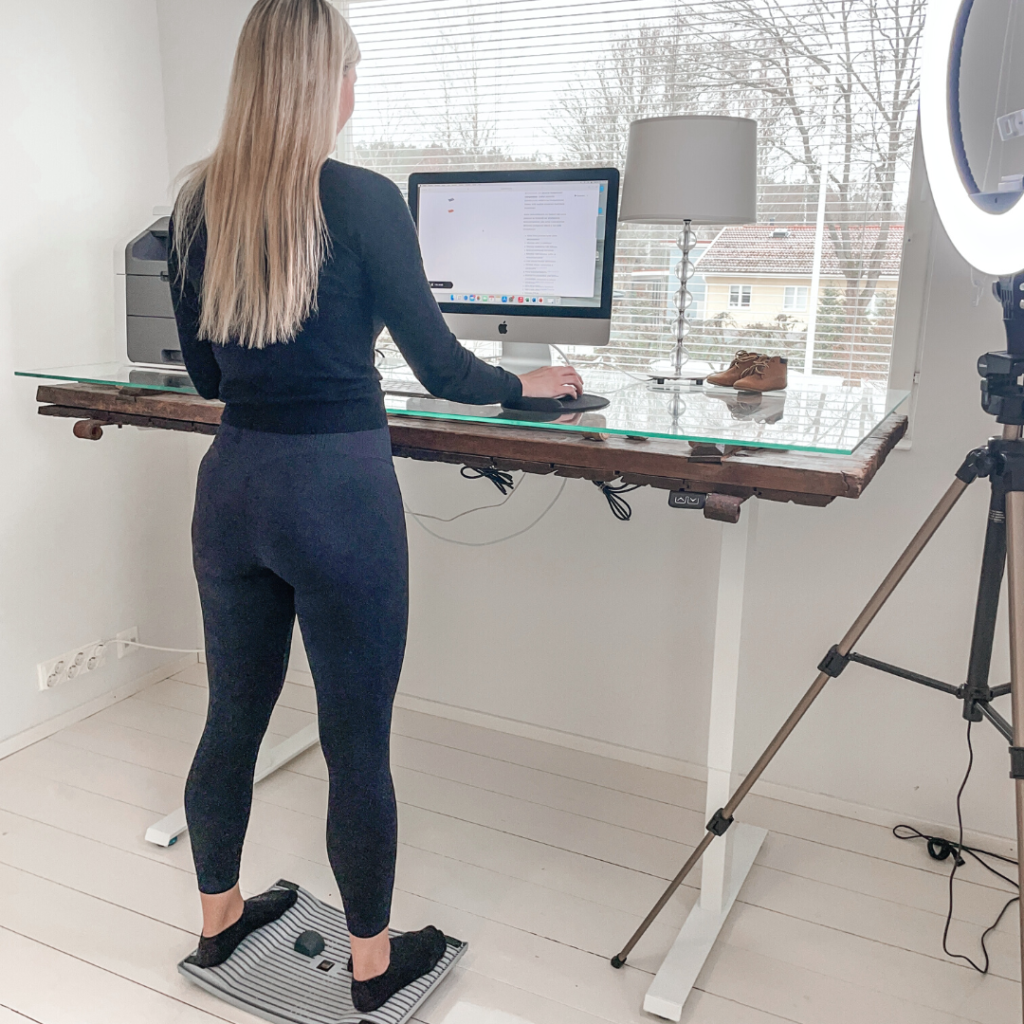
Movement also plays a direct role in spinal disc health. Spinal discs have no direct blood supply and rely on the compression and decompression of movement to exchange nutrients and waste. Without this mechanical pumping, disc health deteriorates over time. Even small, frequent movements, such as shifting weight while standing, gently rocking, or performing micro-movements at an active workstation, can meaningfully reduce the strain that accumulates during a desk job. Our Gymba Activation Board is designed specifically for this purpose, allowing users to make walking-like movements while standing at a height-adjustable desk, keeping circulation and spinal loading active throughout the day.
What role do core and glute weakness play in office back pain?
Core and glute weakness play a central role in office back pain because these muscle groups are the primary stabilizers of the pelvis and lumbar spine. When they are weak or inactive, the lower back muscles are forced to compensate, taking on a load they are not designed to sustain. This overloading is one of the most overlooked but significant contributors to chronic lower back pain in sedentary workers.
Sitting for long periods actively inhibits the glutes. The prolonged hip flexion of sitting causes the glutes to remain in a lengthened, passive state, which over time reduces their ability to generate force and maintain pelvic alignment when standing or walking. This condition is sometimes referred to as gluteal amnesia, and it leaves the lower back exposed to excessive stress during everyday movements.
The deep core muscles, including the transverse abdominis and multifidus, are responsible for providing segmental stability to the lumbar spine. When these muscles are underactive, the spine relies more heavily on passive structures like ligaments and discs to manage load. This passive reliance increases the risk of injury and accelerates the development of pain. Strengthening these muscles through targeted exercise, and keeping them activated during the workday through active standing and balance work, provides meaningful protection against lower back pain.
When should office workers be concerned about back pain?
Office workers should be concerned about back pain when it is persistent beyond a few weeks, when it radiates down one or both legs, when it is accompanied by numbness or tingling, when it disrupts sleep, or when it appears alongside other symptoms such as unexplained weight loss or bladder changes. Most desk-related back pain is mechanical and resolves with movement, posture correction, and ergonomic adjustments. Pain that does not follow this pattern warrants professional assessment.
Radiating leg pain, often described as sciatica, suggests that a spinal nerve may be compressed or irritated. This is a different condition from general muscular lower back pain and requires a different approach to treatment. Similarly, numbness or weakness in the legs is a signal that nerve involvement may be more significant and should not be managed through self-care alone.
For the vast majority of office workers, back pain falls into the category of non-specific lower back pain with identifiable postural and behavioral causes. In these cases, early intervention through workstation adjustments, regular movement breaks, and targeted strengthening is highly effective. The concern is not that back pain will inevitably become serious, but that ignoring it allows the contributing habits and weaknesses to deepen, making the problem progressively harder to reverse. Acting early, before pain becomes chronic, is always the more effective strategy.
Ready to create a healthier workspace?
If this article has helped you identify what is driving your back pain, the next step is making practical changes to your workstation and daily movement habits. Gymba Ergonomics offers a range of ergonomic products — from the Gymba Activation Board to the ergonomic laptop stand — designed to reduce the physical strain of desk work in a straightforward, sustainable way. Browse the full range at gymba-ergonomics.com and find the solution that fits your working setup.