
Working a desk job carries real health risks, particularly for people who sit for most of their working day. Prolonged sitting is linked to a range of physical and mental health problems, from musculoskeletal pain and poor circulation to an increased risk of cardiovascular disease and reduced cognitive performance. The good news is that targeted changes to how you work can meaningfully reduce these risks, and the sections below break down exactly what the research tells us and what you can do about it.
How does prolonged sitting affect the body?
Prolonged sitting slows circulation, reduces muscle activity, and places sustained pressure on the spine and surrounding tissues. When you sit for extended periods, the large muscle groups in your legs and core become largely inactive, your metabolic rate drops, and blood pools in the lower limbs rather than circulating efficiently. These effects begin within the first hour of uninterrupted sitting.
The postural demands of desk work compound these problems. Most people naturally slouch forward as the day progresses, which compresses the lumbar discs and shortens the hip flexors. Over time, this creates a pattern of muscular imbalance where certain muscles become chronically tight while others weaken from disuse. The result is a body that is structurally less equipped to handle everyday movement, even outside working hours.
Circulation is particularly affected. Reduced leg movement means the calf muscles, which act as a secondary pump for venous blood return, are barely engaged. This contributes to swelling in the lower legs and feet, and over the long term, increases the risk of deep vein thrombosis in people who sit for many hours without breaks.
What are the most common musculoskeletal problems from desk jobs?
The most common musculoskeletal problems from desk jobs are lower back pain, neck and shoulder tension, and repetitive strain injuries in the wrists and forearms. These conditions develop gradually through a combination of poor posture, static muscle loading, and repetitive movements such as typing and mouse use sustained over years of office work.
Lower back pain is consistently the most reported complaint among office workers. Sitting increases the load on lumbar discs compared to standing, and when posture deteriorates through the day, that load becomes unevenly distributed. Tight hip flexors from prolonged sitting also tilt the pelvis forward, which increases lumbar curvature and strain.
Neck and shoulder problems often stem from monitor height and position. A screen that is too low forces the head forward and downward, placing significant load on the cervical spine. For every inch the head moves forward from its neutral position, the effective weight the neck muscles must support increases substantially. A Gymba® Laptop Stand for better posture can help position screens at a more neutral height to reduce this strain.
Wrist and forearm conditions, including carpal tunnel syndrome and tendinopathy, develop from sustained low-level muscle activation during typing. Unlike acute injuries, these conditions are cumulative and often go unnoticed until they become chronic and harder to treat.
Can sitting all day increase the risk of serious disease?
Yes, sitting all day is associated with a meaningfully increased risk of serious chronic diseases, including cardiovascular disease, type 2 diabetes, and certain cancers. This association holds even among people who exercise regularly outside of work, which is why sedentary work is increasingly treated as an independent health risk factor rather than simply a consequence of low overall activity.
The mechanism behind cardiovascular risk is partly metabolic. Extended sitting suppresses the activity of lipoprotein lipase, an enzyme that plays a key role in processing fats in the bloodstream. When this enzyme is underactive, triglycerides accumulate and HDL cholesterol levels fall, both of which are markers associated with cardiovascular disease.
The link to type 2 diabetes is connected to insulin sensitivity. Muscle contractions during movement help the body use glucose effectively. When muscles are inactive for long periods, insulin sensitivity decreases, meaning the body must produce more insulin to manage blood sugar. Over years, this can contribute to the progression toward type 2 diabetes.
It is worth being clear that sitting itself is not the sole cause of these conditions. Sedentary work is one risk factor among many, and its effects interact with diet, sleep, stress, and genetic predisposition. However, the evidence is strong enough that reducing prolonged sitting time is now recommended as a meaningful health intervention in its own right.
How does desk work affect mental health and cognitive performance?
Desk work affects mental health and cognitive performance through several interconnected pathways, including physical inactivity, prolonged screen exposure, high cognitive load, and limited natural light. Office workers who sit for most of the day report higher rates of fatigue, difficulty concentrating, and symptoms of anxiety and low mood compared to those with more physically active roles.
Physical inactivity is central to this. Movement stimulates blood flow to the brain and supports the release of neurotransmitters involved in mood regulation and focus. When the body is sedentary for hours at a time, this stimulation is absent, which can contribute to mental fatigue and reduced alertness by the afternoon.
Cognitive performance is also affected by the cumulative stress of sustained concentration without adequate recovery. Deep focus is a finite resource, and without movement breaks that allow the mind to reset, the quality of thinking deteriorates across a working day. This is not simply tiredness but a measurable reduction in working memory, decision-making quality, and creative thinking.
Prolonged screen time adds another layer. Eye strain, headaches, and disrupted sleep from evening screen exposure all affect how well people feel and perform, and these effects compound over time in roles where screen work is unavoidable.
Does standing at a desk actually reduce these health risks?
Standing at a desk reduces some of the health risks associated with prolonged sitting, but only when done correctly and combined with movement rather than used as a simple replacement. Standing engages more muscle groups than sitting, improves circulation, and reduces the spinal compression associated with a seated posture. However, standing still for long periods creates its own problems, including lower limb fatigue and an increased risk of varicose veins.
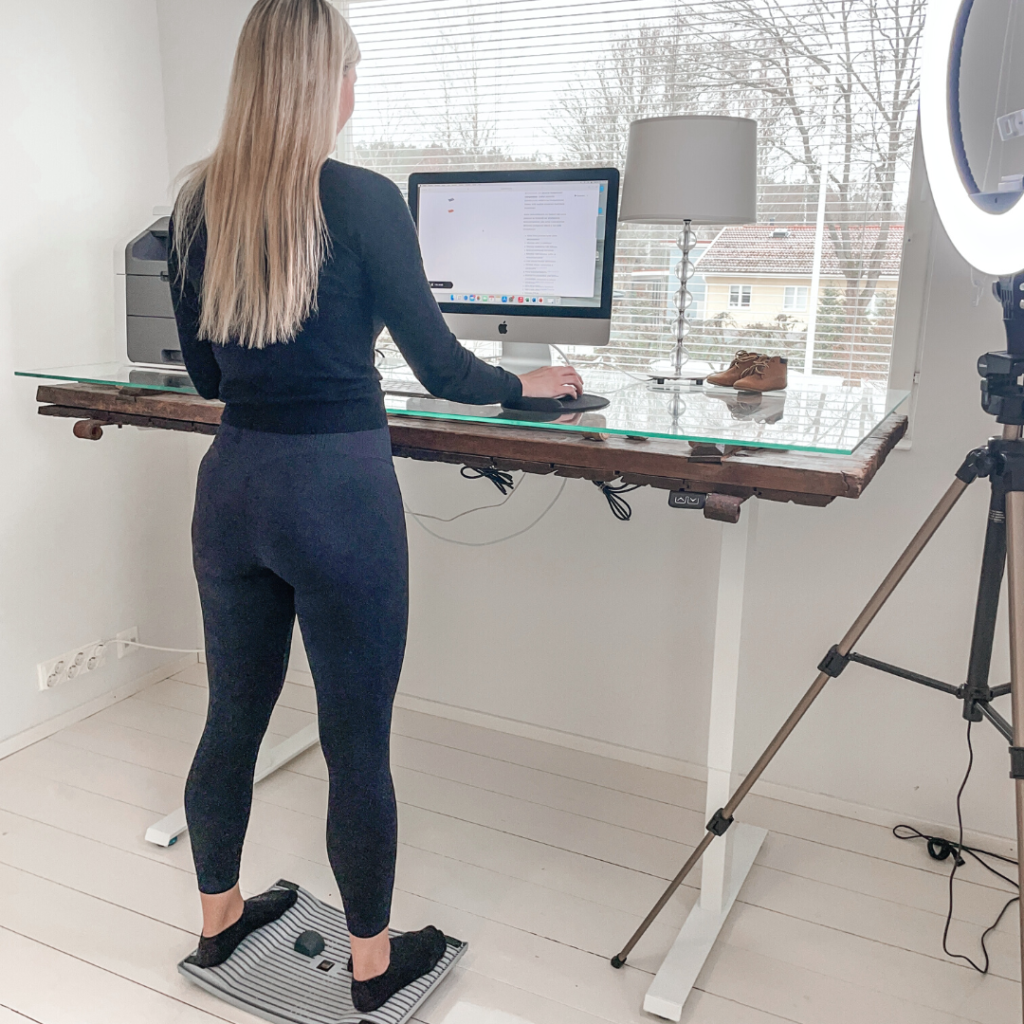
The key distinction is between static standing and active standing. Simply swapping a seated desk for a standing one and remaining stationary shifts the problem rather than solving it. Active standing, where small movements, weight shifts, and subtle balance adjustments are made continuously, is significantly more beneficial. This is the principle behind products like the Gymba Activation Board, which we designed to encourage natural, walking-like movement while working at a height-adjustable desk.
The most effective approach is to alternate between sitting and standing throughout the day rather than committing entirely to one posture. Transitioning every 30 to 60 minutes, combined with genuine movement breaks, delivers the greatest benefit for circulation, musculoskeletal health, and sustained energy levels.
What small changes can offset the effects of a sedentary desk job?
Several small, practical changes can meaningfully offset the health risks of a sedentary desk job without requiring a complete overhaul of how you work. The most effective strategies focus on breaking up sitting time, introducing movement at the workstation, and addressing posture throughout the day.
- Break up sitting every 30 to 60 minutes: Stand, walk to a colleague, or do a brief stretch. Even two to three minutes of movement interrupts the physiological effects of prolonged sitting.
- Use a height-adjustable desk: Alternating between sitting and standing throughout the day reduces cumulative spinal load and keeps circulation more active.
- Introduce active standing tools: Balance boards and mini balance boards encourage small, continuous movements while standing, which is far more beneficial than static standing.
- Optimise your workstation ergonomics: Ensure your monitor is at eye level, your keyboard and mouse are at elbow height, and your chair supports your lumbar curve. Poor ergonomic setup accelerates musculoskeletal strain.
- Stretch regularly: Short mobility exercises targeting the hip flexors, chest, and upper back counteract the postural effects of sitting. A stretching stick or similar tool makes this easier to do at the desk.
- Walk during calls: Any meeting or call that does not require a screen is an opportunity to move. This is one of the simplest and most underused strategies for adding activity to a desk-based day.
- Use foot massage and circulation tools: Foot rollers and massage tools used under the desk stimulate circulation in the lower limbs during seated work, helping to counteract the pooling effect of prolonged sitting. You can explore the full range of ergonomic products for desk workers designed to support this.
None of these changes require significant time or disruption. The underlying principle is consistency: frequent, small interventions across the day are more effective than a single bout of exercise before or after work. Building movement into the structure of the working day, rather than treating it as something separate, is the most sustainable approach to managing the health risks of a desk job. The full Gymba ergonomic product range is available for those looking to equip their workspace with tools that support this approach.
Ready to build a healthier ergonomic workspace?
If this article has prompted you to think more seriously about how your workspace affects your health, the next step is straightforward. Browse the Gymba ergonomic product range to find tools designed specifically for desk workers — from active standing boards and laptop stands to balance boards and circulation aids. Each product is built around the same principle this article describes: that consistent, small movements throughout the day make a genuine difference to how you feel and function at work.