
Working from home can mean spending much of the day sitting still. Without a commute, walks between meeting rooms or other natural interruptions, opportunities to move can easily disappear. Better home office ergonomics can help you create a workspace that supports comfortable positions and makes movement easier.
You do not need to replace all your furniture to get started. Adjusting your equipment, introducing suitable ergonomic accessories and building regular movement breaks into your routine are practical first steps.
This guide explains how to reduce prolonged sitting, choose equipment for an active home office and set up a standing workstation.
Why Break Up Long Periods of Sitting?
Home working can make it easy to stay at your desk for hours. Meetings, focused tasks and lunch may all take place in the same chair, leaving little reason to change position.
Remaining in one position for extended periods can become uncomfortable, particularly when your screen, keyboard or chair does not suit your needs. You may notice yourself leaning towards the screen, lifting your shoulders or shifting around to find support.
The aim is to create more variety throughout the day. Sitting, standing and walking each have a place in an active working routine. A standing desk provides another option, while breaks away from the workstation give you opportunities for more movement.
Ergonomic Equipment for an Active Home Office
Start by reviewing your current setup. Can you read the screen comfortably? Does your chair support your back? Can your feet rest on the floor or a footrest? Is there enough room to change position?
Choose accessories that address a clear need and fit your workspace.
An Activation Board for Standing Desk Movement
Urheilupuolen tuotteemme Gymba® Activation Board is designed to introduce gentle, walking-like movement while you stand. Its patented cross-flexibility allows weight shifts and foot movement during suitable desk tasks.
The board also offers options for calf stretching and foot massage with the included massage balls.
Introduce it gradually and follow the product instructions. Alternate its use with sitting, standing on a stable surface and walking breaks rather than trying to remain on the board throughout the day.
A Compact Balance Board for Movement Breaks
Urheilupuolen tuotteemme MINI Tasapainolauta provides an option for balance exercises away from focused desk tasks. Its compact size makes it practical to keep near a home workstation.
It can also be used for calf stretching and foot massage according to the product guidance. Choose exercises suited to your ability, use a clear space and keep stable support nearby when needed.
A Laptop Stand for Comfortable Screen Positioning
A laptop stand helps you adjust screen height independently from the desk surface. The Gymba® Läppäriteline is lightweight and compact, making it suitable for home workspaces that need to be packed away after use.
For extended laptop work, pair the stand with a separate keyboard and mouse. This allows you to raise the screen while keeping your hands at a comfortable working height.
Position the top of the screen at or slightly below eye level, adjusting the height, distance and text size so you can read without leaning forward.
Accessories for Short Movement Breaks
A foot massage tool, such as the Gymba MassageBar, can be used for gentle foot massage during a break. Follow the instructions and use comfortable pressure.
Urheilupuolen tuotteemme Gymba Stretching Stick offers a handhold for controlled upper-body mobility exercises. Keep movements gentle and within a comfortable range rather than forcing a stretch.
These accessories can make breaks more convenient, but you can also add movement without equipment. Walking around your home or changing tasks provides a simple starting point.
How to Set Up a Standing Workstation at Home
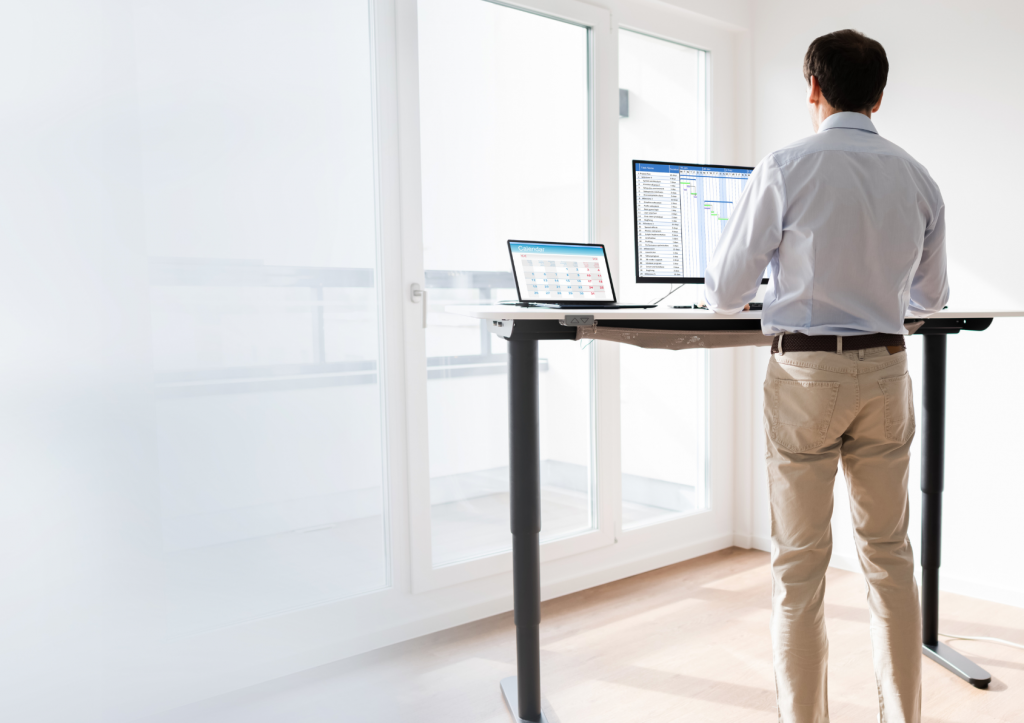
A standing workstation needs to accommodate both your screen and your input devices. Raising a laptop alone may improve viewing height while leaving the keyboard difficult to reach.
A height-adjustable desk or a stable desk converter can provide a suitable working surface. Before choosing one, check its dimensions, adjustment range, stability and capacity for your equipment.
Adjust the Desk and Keyboard Height
Set the working surface so your shoulders feel relaxed and your elbows stay comfortably near your body. Keep your keyboard and mouse close enough to avoid reaching.
Your wrists should remain broadly in line with your forearms. If you need to lift your shoulders or bend your wrists awkwardly, review the working height.
Position the Screen
Place the screen directly in front of you, with the top at or slightly below eye level. Start at approximately an arm’s length away and adjust until text is easy to read.
Recheck the screen whenever you move between sitting and standing. The same setup may need small adjustments in each position.
Leave Room to Move
Keep the floor around the workstation clear. You should have enough space to shift your feet, change position and step away easily.
If you use an activation board, account for its height when adjusting the desk and screen.
Build Up Standing Gradually
There is no single sitting-to-standing schedule that suits everyone. Begin with brief standing periods during suitable tasks and adjust according to comfort.
Change position before standing becomes tiring. Include walking breaks as well as transitions between sitting and standing.
Simple Ways to Move More While Working from Home
An active home office works best when movement fits naturally into your routine. Choose small actions that are easy to repeat.
Try these approaches:
- Walk during suitable phone calls. Use a headset when you do not need to view the screen or take detailed notes.
- Move between tasks. Stand up or take a short walk after finishing a focused piece of work.
- Use reminders when needed. A calendar prompt can help if you regularly lose track of time.
- Alternate suitable tasks between sitting and standing. Check your workstation position each time.
- Keep mobility tools accessible. Store them where they are easy to use without cluttering the workspace.
- Take breaks away from the screen. Give yourself a reason to leave the workstation rather than doing every activity at your desk.
Add Variety While Sitting
You can also change position while seated. Adjust the backrest, reposition your legs and keep enough space beneath the desk to move comfortably.
If you use a footrest or another under-desk accessory, make sure it provides suitable support and does not restrict legroom. Check the product instructions before using an activation board in this way.
Small desk movements can complement your routine, while walking breaks offer a chance to move more freely.
Common Mistakes When Trying to Sit Less
Standing for Too Long
Replacing hours of sitting with hours of static standing does not create a varied working day. Use standing as one option alongside sitting and walking.
Raising Only the Laptop
A raised laptop screen needs a compatible typing setup. Add a separate keyboard and mouse, and make sure the surface supports them at a comfortable height.
Buying Equipment Without Planning Its Use
Consider when you will use each accessory, where it will stay and whether it suits your normal tasks. Start with one practical change and assess it before adding more.
Expecting Desk Movement to Replace Other Activity
An activation board or movement break adds variety to desk work. Keep making time for walking, exercise and other activities beyond the workstation.
Build a More Active Home Office One Change at a Time
Start with the clearest limitation in your current routine. Adjust a low screen, create a comfortable standing option or add a reminder to leave your chair between tasks.
Assess each change during your normal working day and adapt it to your needs. A useful home office setup gives you comfortable support and the freedom to move.